 expertise
The use of APIs has become standard. These days, each of us is already using numerous APIs without even noticing. Often, when introducing APIs, companies focus too hard on technical feasibility instead of putting the business process in the foreground. The key is to combine both API technology and classic integration requirements and leverage the best of both worlds. A very good description of how this has been done can be found in this blog article by Oliver Rupprecht from Osram. The main focus should be on truly understanding the requirements of the business processes and then addressing them accordingly.
API integration closes the gap between the business process and technical requirements
Integration scenarios are often complex because they have to simultaneously meet many different requirements. They involve integrating a wide variety of systems with a number of different technical interfaces and formats while mapping the steps in the individual processes, each of which naturally has its own requirements in terms of processing time, error tolerance, and traceability.
One possible strategy for managing this complexity is to implement all the integration steps and processes onto a single platform. This not only saves direct costs through a better use of resources, but also offers greater operational reliability. However, a possible disadvantage may be that the central integration platform does not provide the optimal tool for every step required in a process.
Challenges illustrated by the example of a web shop
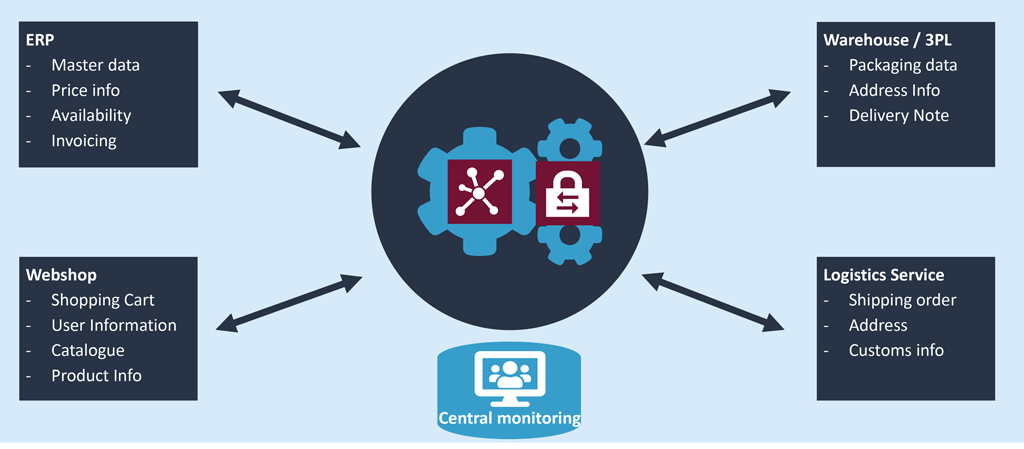 Figure 1: Diagram of the systems involved in a web shop order
Everyone has ordered from an online shop at some time or another – but often little thought is given to what the process involves. First of all, it is important to have relevant information for all the items in the shop and to keep this up to date. In addition to the usual master data, this also includes product descriptions, images, videos, customer ratings, sizes and much more. Often this data has originated from several systems, all with with different interfaces, and exists in a variety of formats. It has to be aggregated in either the shop or in the underlying catalog system. For this purpose, all systems and partners involved need to be connected via supported interfaces . Thomas Kamper describes in detail how this can be done in his blog Legacy System Integration via APIs. Of course, this data needs to be updated regularly. However, this is not necessarily done in real time, but usually at times when the platform and systems are less busy.
There is also data that needs to be displayed to the user in real time, such as price, availability, and delivery time. Even though this information may come from different sources, the user expects this information instantaneously, after just one click! As a rule, the price at least comes from the main ERP system. To determine availability and the delivery date for orders involving several articles, information from a logistics service provider is also often required. As soon as the customer clicks on the “Buy” button in the web shop, the logistics and invoicing processes start. The contents of the shopping cart are transferred to the ERP system in order to generate an order confirmation and later create the invoice. In addition, the data is sent to payment service providers such as PayPal or a credit card company, and to the shipping department or dispatch service provider, who packs the goods and hands them over to the carrier. The customer naturally expects to be informed at every step of the process.
These days, customers expect to receive as standard:
- an order confirmation including an expected delivery date ,
- a notification once the goods have been shipped,
- an update on the expected delivery date, and
- to be notified at key stages in the transportation of the goods.
Obviously, all the systems involved require different data, which need to be provided in different formats. Of course, not all systems have the same technical interfaces, and not all steps in the process are as time-critical as each other.
But as already mentioned, everyone has ordered online at some point, and is so familiar with the process that they expect it to run smoothly and in real time –after all, it’s standard, isn’t it?
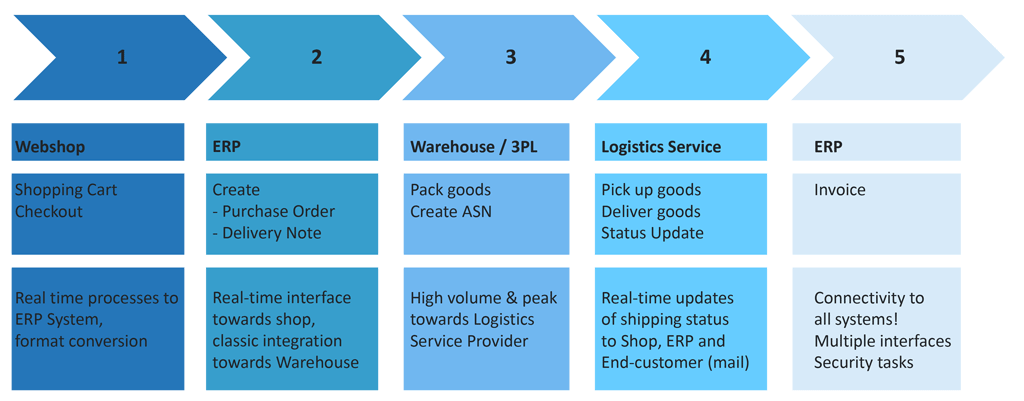 Figure 2: Process steps during a purchase transaction in an online shop
API integration: Achieving results with the right tools and the necessary skills
As usual, the key is to know in detail what is required for at each step of a process and to translate these into technical specifications. You also need to be aware of any effect one process may have on another. For example, a mass mailing of invoices or delivery notes could potentially interfere with a simultaneous, highly time-critical API call, e.g. the API call to trigger an order when a customer finally clicks “Buy” . This type of conflict needs to be avoided at all cost.
Time-critical processes, therefore, need to be treated differently to las urgent process steps which have no one is sitting in front of the screen waiting for something to happen. This “special treatment” can take several forms. In the simplest case, it may be possible to implement processes in a different, cleverer way or to split them into individual steps. Other possible solutions could be to better assess system resources or to split processes between different (virtual) platforms. Which course or combination of approaches is best usually depends on several of the factors described so far. The experienced craftsman will immediately reach for the right tool, the apprentice may need a few tries – it would just be a shame if the right tools were not available or if it was too much effort to use them.
How SEEBURGER can help
With its Business Integration Suite and its B2B/EDI, MFT and API solutions, SEEBURGER can provide you with a central platform that can easily and securely handle these demands.
SEEBURGER’S API Integration Service, is a cloud-based that is has been specifically designed to reliably map real-time requirements while preventing any clashes with other processes. In order to use the right tool to implement real-time processes, the BIS Channel Engine uses channels. The in-memory processing of these channels ensures fast processing. Of course, the service can easily integrate legacy backend systems as well as serving API-enabled systems with true real-time requirements.
This API Integration Service is supplemented by two classic Integration Services B2B/EDI Full Service and iPaaS Service. These are also based on the Business Integration Suite and can, of course, be easily combined with the API Integration Service.
SEEBURGER offers its API integration service as a fully-managed service. Of course, it also offers a wealth of pre-configured connectors, which makes it easier to implement with your existing tools, ensuring.the best possible technical solution for your specific needs. As with any SEEBURGER cloud service, various SLA, DR and service management options are available along with support from our consulting team.
Source: https://blog.seeburger.com/api-integration-challenges-with-api-real-time-processes/
You may also like

