 expertise
Migration to S/4HANA is a strategic decision, one that requires considerable effort and time. The areas of EDI and wider general integration capability can be easily overlooked. However, they often play a pivotal role in the day-to-day functioning of the business, and as such need to be incorporated into SAP S/4HANA migration planning.
Greenfield or Brownfield – For S/4HANA it Makes No Odds
In our previous blog, we discussed the pros and cons of taking a greenfield (start afresh) or brownfield (use what you have already) approach when migrating to S/4HANA. Regardless of whether you take the green pill or the brown pill, there is a common pitfall that should be avoided across both migration strategies.
That pitfall is not taking the entire integration landscape requirements into consideration when migrating to S/4HANA. It’s all too easy to focus on the close-proximity systems impact of the S/4HANA migration, rather than focussing on the entirety of your IT integration landscape, including areas such as:
- Internal Integration of other SAP solutions
- Internal Integration with internal non-SAP systems
- External Integration with Trading Partners, Clouds, Business-to-Government (e.g. B2G E-Invoicing)
Consider the approach outlined below:
Taking SAP S/4HANA Integration to the Firewall, and Beyond
The firewall we would encourage you to focus in terms of integration requirements because it is the differentiator between internal and external integration. Start at your SAP system, and work your way out towards this boundary, taking note of the integration requirements of those IT systems that benefit from SAP oriented data (either consuming it or generating it). In fact, don’t stop there, keep going and take into account any 3rd party systems or cloud services that you connect with that again benefit from access to SAP oriented data. An example of this could be e-invoicing solutions that are provided as cloud services, such as those provided by SEEBURGER. 3rd party systems and services like these may use more traditional methods of connectivity such as EDI, or emerging methods such as APIs. The point being that when it comes to integrating your IT landscape in its entirety (not just your core SAP system), you need a platform that can handle all manner of connectivity methods and data integration requirements. You need a platform that can best prepare your datasets for the migration journey.
The SAP Way, or the HIP Way?
By looking at the entire landscape integration requirements up to and beyond the firewall, you will have to come to terms with the enormity of the task that lays ahead. Not only will you have to successfully migrate to S/4HANA, but you also have to accommodate the integration requirements of your entire disparate IT landscape that benefit from SAP oriented data. The question is, how do you best address that challenge? You have two fundamental choices at your disposal:
S/4HANA Option 1 – SAP + SI
The chances are you have been a client of SAP’s for some time, have built a relationship with a System Integrator (SI) for the services work, and feel reasonably comfortable with the modus operandi. Whilst there are many offerings in the SAP arsenal that can achieve many things, offering far and wide-reaching integration across the entire IT landscape is not the main focus. Based on expertise the SI might be able to achieve a variety of typical integrations, achieving full coverage for all the integration needs can be a challenge.
This is why SAP themselves acknowledge the role that experienced integration specialists such as SEEBURGER have to play when addressing migration and integration challenges. Being the longest-serving certified partner of SAP has allowed SEEBURGER to accumulate a wealth of knowledge and capability in our integration platform as described below.
S/4HANA Option 2 – Hybrid Integration Platform (HIP)
True Hybrid Integration Platforms are able to integrate anything with anything else and make the right data available in the right place at the right time. HIPs are able to connect to and orchestrate the flow of data across multiple systems, including SAP S/4HANA. This is illustrated in the diagram below.
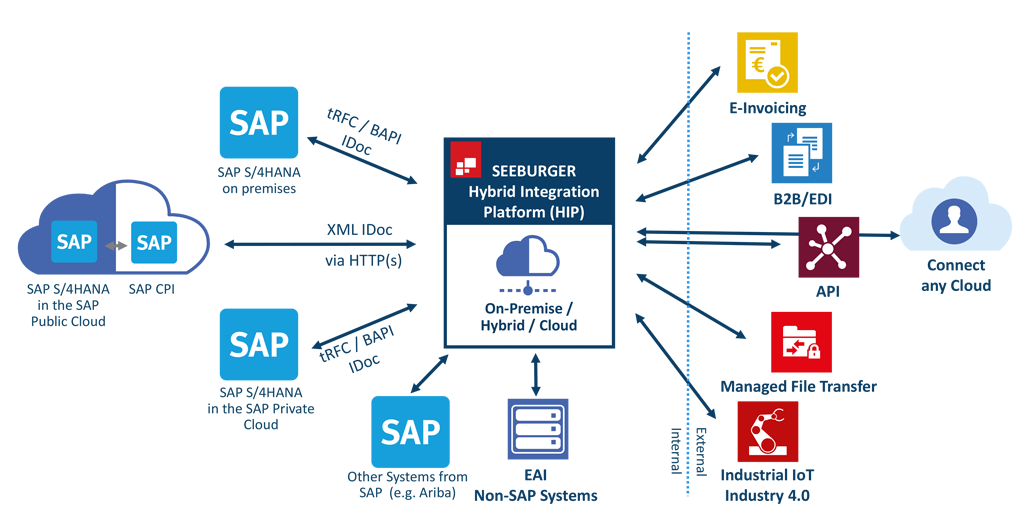 Figure 1: SAP S/4HANA and a Hybrid Integration Platform (HIP)
SEEBURGER’s HIP is able to deliver integration with great expediency by providing off-the-shelf plug-in connectors that are certified to conform to connectivity and data standards (as well as coping with legacy systems). The central workflow engine allows Line of Business requirements to be satisfied and adapted for orchestrating the efficient flow of data amongst systems.
Avoid the Integration Pitfall when migrating to SAP S/4HANA
- Be sure to take the time to carefully evaluate the full systems and services impact of your SAP migration (whether greenfield or brownfield) for all connections up to and beyond the firewall (taking into account 3rd party systems / services).
- Acknowledge the variety of connectivity methods and data integration requirements across the entirety of your landscape. Don’t make integration just the afterthought of your S/4HANA migration.
- Consider engaging with an experienced HIP integration specialist to address the challenges that you will endure during your S/4HANA migration journey.
Source: https://blog.seeburger.com/avoid-this-pitfall-when-migrating-to-sap-s-4hana/
You may also like


The central workflow engine allows Line of Business requirements to be satisfied and adapted for orchestrating the efficient flow of data amongst systems.